Heard about David Ortiz flunking a 2003 test for steroids while driving around a little while ago. Very sad. What we don’t know is whether Ortiz stopped using after he got caught. Still, with Manny Ramírez already outed, the ’04 and ’07 championships seem just a bit tainted now.
The reason I say “just a bit” is that it’s really starting to look as though it would be easier to compile a list of players who didn’t use performance-enhancing drugs during the recently concluded (I hope) Steroid Era.
Given the disproportionate amount of heat they’ve come under, maybe Roger Clemens’ and Barry Bonds’ biggest offenses were being too good — and, of course, being first-class jerks who may have lied under oath.
We’ve had a lively discussion going on in the comments section as to whether steroids and other performance-enhancing drugs actually improve baseball players’ performance. The bottom line: studies of major-league statistics are inconclusive.
But I think we’ve been looking at the wrong thing. As this well-sourced Wikipedia article makes clear, steroid use builds muscle and increases “baseline strength” by somewhere between 5 percent and 20 percent. All things being equal, a baseball player would rather be stronger than not.
I’m old enough to remember the stories about Carl Yastrzemski‘s punishing workouts following the 1966 season, which enabled him to up his homer total from 16 to 44 during the Red Sox’ “Impossible Dream” year. And there’s a reason that Jim Rice had 382 career home runs to Jerry Remy‘s seven. Strength matters, and it always has, long before steroids became available.
But now factor in another 5 percent to 20 percent in chemically induced strength. Granted, some will be able to translate that into more home runs or a harder fastball and some won’t. But to argue that Barry Bonds, Roger Clemens, Mark McGwire et al. would have done just as well without steroids strikes me as silly. We know their enhancements made them stronger. That has to count for something.
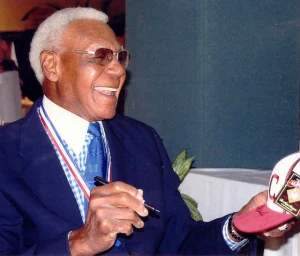
The great Red Sox centerfielder has died at the age of 92. DiMaggio was well before my time, but a few years ago I learned quite a bit about his remarkable life and career in David Halberstam’s book “The Teammates: A Portrait of a Friendship.” Highly recommended.
Since we already know that Manny Ramírez was using steroids, let’s engage in a little open and gross speculation. For all we know, Ramírez had been juicing for years. But there is circumstantial evidence to suggest that he began sometime around the end of the 2007 season.
You may recall that he put up some rather un-Manny-like numbers that year. He hit just 20 homers and drove in a mere 88 runs in 133 games. In 2006, by contrast, he hit 35 homers with 102 RBIs, despite playing in three fewer games. Moreover, in ’07 Ramírez occasionally looked as though his bat was slowing down. Yes, he came alive in the post-season, and he was a key to the Red Sox’ winning the World Series. But he was no longer the Manny of 1998-2005, when he averaged nearly 41 homers and 130 RBIs.
Then came the ’08 season. We were told that he was happier than he’d been in years. The power was back. But his once-harmless antics took a nasty turn. He assaulted Kevin Youkilis. (Yes, Youk can be pretty annoying, but his other 23 teammates somehow manage to restrain themselves.) He assaulted a 64-year-old clubhouse guy. And he sulked his way out of Boston. As Gerry Callahan writes in the Boston Herald, perhaps we were looking at “‘roid rage.”
I am not sure why the Boston Globe’s Bob Ryan wants to give Ramírez any benefit of the doubt.
In one sense, I disagree with both Callahan and Ryan. Ramírez is not stupid. Rather, he is supremely self-centered. The rules have never applied to him, and he knows it. When you consider what he’s gotten away with over the years, why would he think it would be any different this time?
Photo (cc) by Jeff Wheeler and republished here under a Creative Commons license. Some rights reserved.
From the New York Times:
Ramirez said in a statement released by the players’ association that he had been given a medication, not a steroid, that a doctor had recently prescribed him for a personal health issue.
“Unfortunately, the medication was banned under our drug policy,” Ramirez said. “Under the policy that mistake is now my responsibility. I have been advised not to say anything more for now. I do want to say one other thing: I’ve taken and passed about 15 drug tests over the past five seasons.”
If Ramírez had a legitimate reason to be taking whatever he was taking, don’t you think he’d be fighting this tooth and nail? Then again, maybe he’s ready to take 50 games off. It’s been a long season, after all.
Nick Cafardo’s blasé take on the latest Alex Rodriguez controversy has me scratching my head.
In her forthcoming book on A-Rod, Selena Roberts alleges that, when he was with the Texas Rangers, he would sometimes deliberately tip pitches to opposing hitters. It’s nice to know that David Ortiz would “beat the crap out of him” if he were the pitcher and the allegations were true. But why are we not talking about an immediate investigation, followed by a possible lifetime ban?
Cafardo writes in today’s Boston Globe:
This is New York, a city and a team built to handle controversy. So A-Rod took steroids in high school, the book alleges … so A-Rod went to strip clubs … so A-Rod allegedly tipped pitches to opposing hitters … so A-Rod had the Texas clubhouse guy put toothpaste on his toothbrush every day.
Beyond the entertainment value, who cares?
Who cares? Other than the apparent absence of a gambling angle, what A-Rod is alleged to have done is akin to throwing games.
Roberts is no hack — it was she who flushed out the first round of A-Rod allegations, which turned out to be true. Yet no one seems to be all that upset about the possibility that Rose — er, Rodriguez — was stabbing his Texas teammates and fans in the back.
I was working and didn’t see any of Roger Clemens’ testimony. But this, from the New York Times, is enough for me:
Mr. Clemens testified that in those conversations with Mr. Pettitte, he was talking about his wife’s use of H.G.H. one time and on another occasion was referring to something he saw on a television show. Mr. Clemens sought to rebut Mr. Pettitte’s sworn and damaging statements to the committee that Mr. Clemens told him point blank that he had used H.G.H.
But Henry A. Waxman, the California Democrat who chairs the committee, clearly did not believe Mr. Clemens, and pointed out that Mr. Pettitte’s wife, Laura, had also given an affidavit in which she confirmed that her husband told her about his conversation with Mr. Clemens shortly after it took place.
As ridiculous as Clemens’ insistence that he didn’t use performance-enhancing drugs may be, you certainly couldn’t throw the book at him on Brian McNamee’s say-so. A lot of observers have fallen for the ridiculous notion that McNamee had no incentive to lie. In fact, he had every incentive to say what prosecutors wanted him to say. Pettitte, on the other hand, is a longtime friend of Clemens who is facing no legal consequences for any of this.
It’s over. Never mind whether Clemens will go to the Hall of Fame. He could soon be facing much more serious problems. To quote U.S. Rep. Elijah Cummings, D-Md., “Mr. Clemens, once again I remind you, you are under oath.”
How was it that the names of players who were not in the Mitchell Report wound up being identified as steroid users earlier in the day? As Dan Shaughnessy writes in the Boston Globe, “Some of the names were pretty interesting. Where do those players go to reclaim their reputations?”
By many accounts, the false positives originated with WNBC in New York, which posted a correction late in the afternoon, after George Mitchell had finally released his report. But was WNBC alone, with others merely following the station’s lead? Or were there others who also broke this toxic non-story?
Shouldn’t we make a moral distinction between Roger Clemens and Barry Bonds, who’ve been accused of taking steroids in order to throw harder and hit the ball farther, and Andy Pettitte and Mo Vaughn, who alleged took human growth hormone so they’d be able to bounce back from injuries more quickly? It seems to me that the former compromised the integrity of the game, whereas the latter was merely dangerous and stupid.
Here’s a PDF of the Mitchell report. Search for Pettitte’s and Vaughn’s names and you’ll see what I mean.
Only one thing surprises me about the news that Roger Clemens looms so large in George Mitchell’s report on steroids. I had been under the impression that a pitcher couldn’t use steroids for very long without breaking down. On that basis, I had been willing to give him a pass. But I guess I was wrong.
OK, back to work.