For their final project, my graduate students in Fundamentals of Digital Journalism had to produce a story on a topic of their choosing that included three elements: a bloggy feature story (bloggy because it’s full of links), photos and a video.
Their reporting took them from a program in New York that promotes alternatives to prison to a horse farm in Goffstown, New Hampshire, for kids with disabilities. Most of their stories, though, were based in the Boston area.
There’s some good work here, and I hope you’ll take a look at the map. Each marker will take you to a different story. You’ll need to zoom in on Boston.
The timing was serendipitous. As the media swarmed around Newtown, Conn., following last Friday’s horrifying massacre, some observers were beginning to ask why so little attention was being paid to the ongoing crisis of urban violence. (Here’s one example, from The Phoenix’s Chris Faraone.)
On Sunday, the Boston Globe provided an answer of sorts: the first installment of “68 Blocks: Life, Death, Hope,” a five-day, multi-part series on Dorchester’s Bowdoin-Geneva neighborhood — a predominantly African-American community that is a vibrant center of family life but that is also beset by gangs and guns. The Globe went all in. The paper even rented an apartment in the neighborhood, where two of its reporters, Meghan Irons and Akilah Johnson, lived during the five months that they and others were doing their reporting.
It was only a week ago that the paper published an ambitious three-part series on the problems of immigration. The long-term prospects for the newspaper business may be bleak, but the Globe continues to produce important, expensive, time-consuming work.
At a time when you sometimes hear that various forms of digital storytelling have made narrative obsolete, “68 Blocks” is an example of how digital and narrative can work together. The story itself — 29,000 or so words spread out over five days — is unusual for newspaper writing. There is no news hook and, in the end, no real conclusion.
Thus we are left to wonder if Nate Davis and his wife, Trina Fomby-Davis, will be able to move on with their lives after the murder of one son and the imprisonment of another; if “Tal” will ever make something of himself; if Father Doc Conway can truly make a difference; and if Jhana Senxian will succeed in her efforts to remake her small part of Bowdoin-Geneva.
But if you’re only reading “68 Blocks” in print, you’re missing a lot. Fortunately the Globe has dropped the paywall for this package, so you can take the time to explore. It stands as a lesson in how to do multimedia, how to use data and how to involve your readers — “the people formerly known as the audience,” as Jay Rosen calls them — to help tell their own stories. For instance:
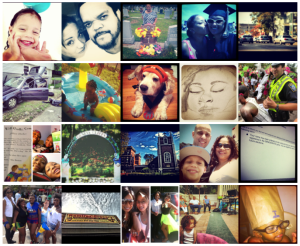
• Instagram and voices from the neighborhood. My students and I have taken several tours of the Globe Idea Lab, an innovation skunkworks inside the paper’s Dorchester headquarters. The lab is dominated by a giant vertical screen comprising nine smaller screens. On it is a map of Boston, with geotagged Instagram photos popping up as soon as people post them. The Globe tracked down some of the amateur photographers in Bowdoin-Geneva, got their permission to use their pictures (unlike, uh, Instagram) and recorded brief audio interviews to go with each one. Rachel McAthy has more at Journalism.co.uk.
• Kids using video to tell their own stories. This might be my favorite: the Globe distributed video cameras to young people in the neighborhood and posted the results. There are six short videos online, and every one is worth watching.
• Interactive data visualizations. Using maps and charts, “68 Blocks” lays out in graphic detail a number of quality-of-life measurements ranging from homicides to rodent activity. By letting the user call up the data she wants, the visualizations invite repeated visits.
All of that is in addition to more typical offerings such as professionally produced videos, slideshows and diary entries written by Globe reporters.
This is a series that should have a long post-publication life — perhaps supplemented by an e-book. It’s a great example of what a large news organization is able to do if it’s got the resources and is willing to commit them to a long, complex project. Those of us who live in Greater Boston are lucky that the Globe is still taking on such important work.
Best wishes to Cathryn Keefe O’Hare, who’s leaving the Danvers Herald, where she has been editor for the past 10 years. I can’t find her farewell editorial online, but in the print edition she writes:
It has been a privilege to work here. I have learned so much, and I have had so much fun through the years. I have helped some of you, I think. I hope I have explained some issues fairly well. In any case, I know you have enriched my life with patience when I’ve been obtuse and offered gracious acceptance of my nosy ways.
In 2008, Cathryn let me tag along and learn about Web video. You can see the results here. Cathryn is a consummate community journalist, and she will be missed by those of us who live in Danvers.
Thomas MacMillan covers a finance committee meeting in New Haven City Hall.
Back when I was covering city council, school committee and board of selectmen meetings in the 1970s and ’80s, the only tool I brought with me was a notebook and a pen.
How times have changed. On Tuesday evening I connected with Thomas MacMillan, a reporter for the New Haven Independent, so I could watch him cover a finance committee meeting. (Click here for a video feature on the Independent, a non-profit community news site.) We met outside the aldermanic chamber in New Haven City Hall just before 6 p.m., and I followed him to the front row.
MacMillan accepted congratulations from a few city officials for a national reporting award he won last week, then settled in to live-blog the debate. He was a bit harried — he’d just come over from covering another event, and he hadn’t had time to write the introduction. A few minutes later, though, he was good to go.
For the next two hours I watched as MacMillan posted a series of updates on what was going on, pored through budget documents, moderated and posted reader comments, periodically jotted a few things down in a notebook (how old-fashioned), and took photos.
Alderman Darnell Goldson, who was sitting in our row, whispered, “Hey, Thomas!”, and pointed behind us, where an otherwise-dignified looking man was wearing a lighted-up Christmas tree on his head. His aim was to protest Mayor John DeStefano’s proposal to save money by not erecting a tree on New Haven Green this year. MacMillan turned and shot.
And when two aldermen got into a semi-heated discussion about cuts to the education budget, MacMillan pulled out another camera and shot some video, although he ended up not using it.
Despite my front-row seat, I would have had little idea of what was going on if it weren’t for MacMillan’s updates, which I read on my BlackBerry.
I left at 8; the hearing ended at 9:30. Later, MacMillan took his blog items and notes and turned them into the story that you can see today, and posted a few photos as well.
What MacMillan did last night was impressive but not unusual. The technical skills he brought to bear on his assignment were nothing that couldn’t be mastered in a few weeks. It’s the mindset that matters. Journalists today must be prepared to juggle a variety of tasks and to perform them with minimal supervision.
And to think that there was a time when the biggest challenge in covering a meeting was to stay awake.
[googlemaps https://maps.google.com/maps/ms?ie=UTF8&hl=en&msa=0&msid=110849334117410151532.00048518b4ffdc95dd0ae&ll=41.656497,-72.388916&spn=2.872863,5.493164&z=7&output=embed&w=500&h=350]
When I first started teaching a course called Reinventing the News a few years ago, I envisioned it mainly as a seminar. The idea was that we would look at some case studies of where the news business might be headed and blog about it.
I quickly realized that wasn’t good enough. The spark for me was a student who had just come back from her co-op job at the Patriot Ledger of Quincy. She had assumed the most complicated tool she’d have to use would be a notebook. Instead, she was tossed a point-and-shoot digital camera and told to teach herself how to capture and edit video. She liked it so much she ended up changing her career goals from print to video.
It was with some trepidation that I began adding three weeks of Web video to Reinventing a year and a half ago. First, I had to teach myself how to do it. And it required exposing some vulnerabilities. I knew some students would be starting from zero, but I also knew that others were already better at video journalism than I’d ever be. Nevertheless, it proved to be well worth it.
Last week we finished the most complex version of Reinventing I’ve offered, and my students had to pull together a variety of skills for their final project. The assignment was to use free online tools to create a multimedia story. The elements:
An 800- to 1,000-word story about a digital media project that had caught their eye, written up as a blog post with relevant links.
A slide show of six to 10 still photos, posted to Flickr and embedded in their blog.
A two- to five-minute video they shot and edited, posted to YouTube and also embedded in their blog.
An explanation of how they used social networks such as Twitter and Facebook to find sources and report their story.
At the end of it all, they were asked to note the location of their story on a Google map and link to their blog post. The result is the map I’ve embedded above. I invite you to explore. These young journalists did a terrific job, and I am very proud of them.
If you click on “View Reinventing the News: Final Projects in a larger map,” directly under the embedded map, you’ll find the list of students on the left-hand side. Click on a name to find his or her spot on the map, each one of which is linked directly to their project. Hmmm … Google could make this a little bit simpler, eh?
I’ll be teaching Reinventing again this fall, and I will continue to refine. My first thought is that I ought to dump the brief wiki exercise I offer and instead delve more deeply into how to handle comments. Any thoughts you have would be welcome.
It wasn’t long ago that a local reporter could head out on an assignment with nothing more than a notebook and a pen. Maybe a camera, but only if there were no photographers available. But those days are rapidly drawing to a close.
Take, for instance, Cathryn Keefe O’Hare, a longtime print and radio reporter who’s been editor of the Danvers Herald since 2000. The Herald is part of the GateHouse Media chain, which is pushing its journalists to supplement their stories with videos for its Wicked Local sites. O’Hare shot video for the first time last Memorial Day. Now she does it regularly.
For a Flickr slideshow of O’Hare shooting and editing her story, click on the photo above.
Last Monday I met her at the Danversport Yacht Club for the eighth annual Dr. Martin Luther King Jr. Awards Dinner. It was a routine assignment — take some notes, write it up. It was also a good opportunity for her to put together a video package. And for me to tag along and watch how she does it.
O’Hare wielded a Casio Exilim ex5600, a tiny, relatively inexpensive piece of technology that shoots still photos, video and audio. She had a simple goal: to ask some of the 450 people who were on hand why they had chosen to attend and what King’s message meant to them. She shot in ambient light, which, as you’ll see, was good enough, if not perfect. Audio is recorded through a microphone in the front of the camera.
O’Hare still finds being a multimedia journalist a challenge. She stands on her tip-toes when interviewing people taller than she. A couple of interviews proved to be unusable. “It’s more stressful than just taking notes,” she says. But she got sufficient material to put together a nice video supplement to her print story.
Three days later I met her in the local GateHouse newsroom in Beverly, where she was editing her clips into a news video. She used Microsoft’s Windows Movie Maker, a free program that lets you cut extraneous material out of the clips, piece them together in any order you like, and add transitions, titles and an extra soundtrack. (The Macintosh equivalent is iMovie.) O’Hare spliced in music from the Follow Hymn Interfaith Choir, which had performed on Monday, to supplement the interviews.
To read O’Hare’s story and watch her video, click on the YouTube graphic above.
Finished videos are uploaded to YouTube and then embedded on the Danvers Herald site. O’Hare still hasn’t figured out how to do that, so she leaves it to one of the regional managing editors, Peter Chianca.
“The thing that remains true, whether it’s in print journalism or the Internet or video, you have to tell a story,” says O’Hare. “And you have to tell it as true as you can make it. And you have to try to speak for those people who can’t tell their story.”
To listen to an audio interview with O’Hare, click here.
To watch other videos from the Danvers Herald, click here.