If you ride your bike in the Boston area, you encounter graffiti pretty much everywhere. It’s obnoxious and unsettling, because it leads to a sense that civic-minded people are on the losing end while vandals are able to gain the upper hand.
Follow my Bluesky newsfeed for additional news and commentary. And please join my Patreon for just $6 a month. You’ll receive a supporters-only newsletter every Thursday.
The Somerville Community Path from Davis Square to East Cambridge is particularly bad, with graffiti overwhelming the walls alongside the MBTA tracks and next to the path itself.
Today, though, I’d like to take a look at a different bike path — the Tri-Community Greenway from Winchester through Woburn and into Stoneham, along with a spur from Winchester to Horn Pond in Woburn. It’s 13.4 miles out and back, and it’s marked with numerous well-designed signs along the way — many of which have been smeared with graffiti.
All photos (cc) 2026 by Dan Kennedy.
As a bike path, the Greenway is more aspirational than it is reality, since much of it follows neighborhood streets. That’s especially true of the southern part of the route up to where you turn east off Central Street in Woburn onto an actual paved path. After that, you’re on a path, though with numerous street crossings.
Earlier this week I rode the entire Greenway, including the Horn Pond spur, and took photos to document what I saw.
This week we learned that the Environmental Protection Agency is proposing to ban trichloroethylene, better known as TCE, an industrial solvent that has been linked to leukemia, birth defects, reproductive problems and other health issues.
As Michael Casey of The Associated Press notes, TCE was at the center of a major story in Woburn, Massachusetts, in the late 1970s and ’80s, when six children died of leukemia and a landmark lawsuit was brought in U.S. District Court. The lawsuit alleged that those deaths and a range of other illnesses had been caused by exposure to TCE in the drinking water. But none of that might have happened if not for the reporting of Charles Ryan, then a young reporter at The Daily Times Chronicle in Woburn. I was working at the paper at the time, and I remember what an enormous impact Charlie’s reporting had on advancing the battle against toxic waste.
Charlie had already reported on the discovery of contamination in the drinking water as well as suspicions that it was linked to a cluster of leukemia cases in East Woburn. The question that had to be answered was whether the cluster was statistically significant enough that it warranted further investigation. In December 1979, the state was about to release the results of a study. Charlie was set to go into Boston and get a copy of the report. Somehow, the story leaked out early, and the Boston Herald American reported the findings: no statistical significance. “I was a little pissed,” Charlie told me years later. “But I went in there anyway.”
Charlie quickly realized that state investigators had made a math error — they were using Woburn’s 1970 population of 40,000, whereas by 1979 that had dropped to 36,000. Correct the denominator, and the leukemia cluster moved into the zone of statistical significance. “That story changed everything,” Charlie told me. His reporting didn’t set well with Woburn’s old-line establishment, and he remembered once being told, “Your father would be turning over in his grave if he knew what you were doing to his city.” Charlie’s response: “That means you didn’t know my father very well.”
Later on, I covered some aspects of the story and was in court for all but five days of the 78-day civil trial. I covered the appeals process, too. The trial was the subject of a terrific book called “A Civil Action,” by Jonathan Harr, and a not-so-terrific movie starring John Travolta. The trial didn’t end well for the eight families who sued. One of the three defendants settled out of court before the trial, a second was cleared by the jury, and the third, W.R. Grace, settled for a paltry $8 million after being found liable for contaminating the water. The jury never had a chance to determine whether the contamination had actually caused the illnesses that were at the heart of the case.
Charlie is now retired after a lengthy career in journalism and continues to live in Woburn. The proposed ban on TCE is long overdue, and it’s part of his legacy as a reporter. It’s also a testament to the vital importance of local news that holds powerful interests to account.
Sports builds character, we are told over and over again. And yet Massachusetts has been hit with multiple cases of racist, homophobic harassment aimed at high school athletes.
🗽The New England Muzzles🗽
The leading journalist tracking those cases is Bob Hohler of The Boston Globe, who’s reported on horrifying cases in Danvers, Woburn, Duxbury and elsewhere. Yet his efforts to dig deeper have been improperly thwarted by the Massachusetts Interscholastic Athletic Association. According to Hohler, the MIAA has refused to turn over incident reports in response to a public records request even though the secretary of state’s office has ruled that those records are, indeed, public. Hohler writes:
Details of the allegedmisconduct remain untold because the MIAA denied the Globe’s request for copies of the incident reports. The denial follows a ruling by the Secretary of State’s office in November that the MIAA, despite the organization’s objections, is a public entity subject to the state’s public records law.
MIAA executive director Bob Baldwin told Hohler that his organization has chosen to ignore the public’s right to know because officials don’t want to discourage schools from reporting incidents of harassment. Yet the lesson of past incidents is that reforms often don’t occur without exposure. For instance, it was only after Hohler reported that Danvers officials had failed to respond to a “toxic team culture” on the boys’ varsity hockey team that the attorney general’s office investigated and local leaders agreed to a series of reforms centered around policies and training. Hohler’s reporting was also followed by several departures, including the retirement of School Supt. Lisa Dana.
More than anything, Hohler’s report on the MIAA this week underscores the inadequacies of the Massachusetts public records law. There are few consequences for officials who refuse to comply with the law, even when they ignore a direct ruling to turn over public documents, as the MIAA is reportedly doing with Hohler and the Globe.
According to Hohler, the MIAA “has received 50 reports involving discrimination, harassment, or bullying — nearly one a week on average while school has been in session — since the organization began requiring its 380 member schools to file discriminatory incident reports starting with the winter season in late 2021.” The public deserves to know more about those reports.
The future of the New England Muzzle Awards
This is the time of year when I would be putting the finishing touches on the New England Muzzle Awards, an annual Fourth of July feature that highlights outrages against freedom of speech in the six New England states. From 1998 through 2012, the Muzzles were published in The Boston Phoenix. After the Phoenix closed in 2013, they were hosted at GBH News.
The one constant over all those years had been my friend Peter Kadzis’ role as editor at both the Phoenix and GBH. Following Peter’s well-earned retirement, I’ve decided that last year’s 25th anniversary edition will be the last. I’ll still track the kinds of stories that I used to highlight in the Muzzles, and the MIAA story would have been a natural. But rather than an annual round-up, I’m going to write them up in real time for Media Nation. You’ll notice a weak attempt at a logo near the top of this post. I’ll try to come up with something better.
I also want to express my appreciation to GBH News for hosting the Muzzles during the final 10 years of their existence, and to civil-liberties lawyer Harvey Silverglate, my friend and occasional collaborator, for coming up with the idea all those years ago.
Later today we’ll be attending a wake for Paul Andrews, the retired superintendent of schools in Woburn, who died last Saturday at 84. Paul led a remarkably long and productive life. I didn’t even know about his service as chair of the board of directors at Winchester Hospital until I read this obituary. I got to know him when I was covering the Woburn Public Schools for The Daily Times Chronicle in the 1980s. At the same time, Paul’s children, Paul, Kevin and Marcia (and occasionally Paul himself), were taking photos for the paper.
I want to share one anecdote that shows Paul’s dedication to doing things the right way. I was covering the Woburn School Committee one evening when the committee voted to go into executive session. I don’t remember the reason; it probably had something to do with contract negotiations with the teachers union. The chair announced that the committee would not be returning to open session, which meant that members of the public — including me — were free to leave.
The next morning, Paul gave me a call to let me know that the committee had, in fact, returned to open session late that night and taken a vote. Of course, there was no one there to witness it. As superintendent, he was the committee’s secretary, so he told me the details of the motion and the vote so I could make some calls and write it up for that afternoon’s paper.
Later on, he told me that several committee members were peeved with him for giving me a head’s-up, and that he had to explain they had violated the open meeting law by returning to public session after announcing they would not do that. He took the hit for their illegal action — something that any reporter who’s dealt with local officials who either don’t understand or don’t respect the public’s right to know can appreciate.
Paul will be greatly missed, and I offer my condolences to his family and friends.
Last week I received some very good news — Jim Haggerty, the editor of The Daily Times Chronicle in Woburn, had been selected to receive the Bob Wallack Community Journalism Award from the New England Newspaper and Press Association. I worked for Jim from 1979-’89, and I was delighted that I was asked to say a few words. Here’s the text of my remarks:
Congratulations to Jim Haggerty for winning the Bob Wallack Community Journalism Award. The award “recognizes an individual who has an exceptional record of commitment to community journalism.” Through his work at The Daily Times Chronicle and through his years of mentoring young journalists, Jim, along with the entire Haggerty family, have shown that they are committed to the highest ideals of local news.
I first met Jim in 1979, when I began working as a part-time reporter covering the town of Winchester. A few months later, after I graduated from Northeastern, Jim hired me. I learned from him and his family what community journalism was about — telling tough stories when they need to be told, but doing it with compassion and with an understanding that holding local government officials, business people and others accountable is not incompatible with treating them like human beings. It’s a lesson I’ve tried to carry with me throughout my own career.
During my 10 years at The Daily Times Chronicle, the paper covered the years-long story of Woburn’s toxic waste tragedy comprehensively and courageously. Families in East Woburn claimed that contaminated drinking water had resulted in their children contracting leukemia and other illnesses. Several of them died. The pressure on Jim and his family from city officials to tone down the coverage must have been overwhelming. But that never trickled down to those of us who were covering the story. Jim’s dedication to journalism and truth-telling during those years was inspiring.
These days, local news is in crisis, as the internet has undermined advertising revenues while corporate chains and hedge funds are slashing the newspapers that they own. The residents of Woburn and the surrounding communities are lucky that The Daily Times Chronicle is still family-owned, still doing good work and still dedicated to the principles that have sustained it for the past hundred years. Best wishes to you, Jim — and good luck to you and your family as you embark on the next hundred.
Update II: And the paragraph has been restored. I’m told there was nothing nefarious about its disappearance.
Update: Oh, my. The nutty last paragraph that prompted this post has been deleted. Not a good look, Harvard.
***
In an otherwise unremarkable story from Harvard Business School about a study into the effects of local newspaper closures on corporate wrongdoing, I ran into this bizarro closing paragraph. The story quotes Professor Jonas Heese, a co-author of the study:
Saving local newspapers isn’t Heese’s specialty, but he points to a recent trend of hedge funds buying up distressed local media outlets as having the potential to stabilize the market and resurrect local news. And that makes him wonder: “Is this a reason to be hopeful?”
No, Professor Heese. It is not a reason to be hopeful. I suggest you stick to statistical analysis, which you seem to be pretty good at. Here’s the abstract, from the Journal of Financial Economics, titled “When the Local Newspaper Leaves Town: The Effects of Local Newspaper Closures on Corporate Misconduct”:
We examine whether the local press is an effective monitor of corporate misconduct. Specifically, we study the effects of local newspaper closures on violations by local facilities of publicly listed firms. After a local newspaper closure, local facilities increase violations by 1.1% and penalties by 15.2%, indicating that the closures reduce firm monitoring by the press. This effect is not driven by the underlying economic conditions, the underlying local fraud environment, or the underlying firm conditions. Taken together, our findings indicate that local newspapers are an important monitor of firms’ misconduct.
Reading this leads me to think about our work at The Daily Times Chronicle in Woburn, when we uncovered a massive toxic waste problem in the early 1980s that may have led to an outbreak of childhood leukemia and other illnesses. Charlie Ryan’s reporting was crucial to breaking the story wide open. In 1998, he recounted in The Boston Phoenix the sequence of events that led the world to understand that Woburn had an environmental and public health disaster on its hands:
Ryan’s most important story came in December 1979, on a development he thought he’d been beaten on. The state’s Department of Public Health was about to release the results of a study on Woburn’s leukemia rate, and Ryan arranged to interview DPH officials. That morning, the Boston Herald American published a front-page story reporting that the leukemia rate was within the normal range for a city of Woburn’s size.
“I was a little pissed,” Ryan remembers, “but I went in there anyway.” He sat down with a DPH statistician, who explained the results to him: essentially, the DPH had taken the number of leukemia cases and divided it by the total population of Woburn, based on the 1970 census. Ryan stopped him. 1970? The population of Woburn, Ryan knew, had fallen from 40,000 to around 36,000. Ryan asked a simple question: What would happen if the lower figure were used? The statistician recalculated the numbers — and, all of a sudden, the number of leukemia cases appeared to be “statistically significant,” the bland-sounding phrase used to describe what was obviously a very real problem.
“That story drastically changed everything,” says Ryan, who got out of journalism a few years ago and now helps run the computers for Essex County Newspapers. “To that point, everyone had considered Anne Anderson to be just a hysterical mom. I think without that story, the Centers for Disease Control, the Environmental Protection Agency, and the state never would have pushed that hard.”
Yes, local journalism is crucial in holding corporations to account, just as it is in keeping an eye on government and other large institutions. But no, hedge funds are not the solution. They’re the problem.
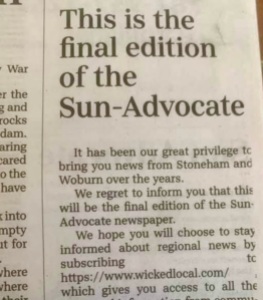
On and on it goes. I was a reporter at The Daily Times Chronicle of Woburn in the 1980s when the Woburn Advocate was launched by a local developer. It eventually fell into GateHouse Media’s and then Gannett’s hands. The Times Chronicle, still owned by the Haggerty family, continues to do good work. The Advocate, meanwhile, was merged with another GateHouse/Gannett paper, the Stoneham Sun, and now is no more.
To the extent that Gannett has any strategy with its most recent closings, the emphasis seems to be on getting out of places where there is competition. The Haggertys, in addition to running the Times Chronicle, also operate The Stoneham Independent.
I’ve heard there may be a couple of other Gannett weeklies in Eastern Massachusetts that have been shut down as well. Keep those tips coming. I’d also love to see any internal memos that lay out all of the closings. Send them along to dan dot kennedy at northeastern dot edu. As always, discretion is assured.
The overwhelming crush of news emanating from the Trump administration makes it all but impossible to give more than passing attention to some of its worst and most damaging acts.
It can’t be helped. Though you could argue that the media pay too much attention to the president’s sociopathic Twitter feed, you certainly can’t fault journalists for focusing on the childish insults he has directed at Justin Trudeau and his embrace of the murderous dictator Kim Jong Un. To its credit, the press has also managed to provide reasonably comprehensive coverage of the administration’s inhumane treatment of refugee families.
But when you get down to wonkish issues like industry-backed changes in the way that the Environmental Protection Agency regulates toxic substances, well, good luck finding the sort of coverage that truly commands attention and sparks outrage. And yes, I’m going to recount some information I learned from a story that appeared on the front page of The New York Times last week, so this is not exactly a secret. But we all know that without amplification from the media echo chamber in the form of follow-up stories, cable news chatter, and the like, important stories tend to fade away pretty quickly.
The Times article, by Eric Lipton, grabbed my attention for a very specific reason: During the 1980s I was a reporter for The Daily Times Chronicle of Woburn, where I reported on families whose children became sick with leukemia — some fatally so — after the city water supply was contaminated with industrial solvents. The families sued the likely polluters, leading to a federal trial that was featured in Jonathan Harr’s riveting book “A Civil Action.” (The book was made into a less-than-riveting movie of the same name.)
A variety of chemicals were at issue in the Woburn case, but the two most important were trichloroethylene (a degreaser) and tetrachloroethylene (also known as perchloroethylene, used in dry cleaning) — both of which are now on the list of substances the EPA wants to ease up on. According to Lipton’s story, the EPA, acting at the behest of the chemical industry, may abandon an Obama-era initiative to measure the effect of these hazardous chemicals in the ground, water, and air, focusing instead on workplace exposure. Yet contaminated drinking water was precisely what was at issue in Woburn.
“The approach is a big victory for the chemical industry, which has repeatedly pressed the EPA to narrow the scope of its risk evaluations,” writes Lipton, who notes that Nancy Beck, the Trump appointee in charge of the initiative, “previously worked as an executive at the American Chemistry Council, one of the industry’s main lobbying groups.”
The 1986 federal case did not end well for the Woburn families — they settled out of court for short money after the trial ended in a muddle. But they left a legacy regarding what can happen when industry is allowed to dispose of toxic waste without regard for safety or health. Now that legacy is under attack. The media need to shine a light on this story — and to keep shining it until the EPA backs down.
An ambitious challenge
There was a time not too many years ago when newspaper owners hoped they would develop an advertising-based business model for online content that would allow them to earn profits while giving away their journalism. Craigslist, Google, and Facebook put an end to those dreams. In recent years, the emphasis has been on persuading readers to pay for digital news.
Now The Sacramento Bee has issued a challenge to its readers. Editor Lauren Gustus has written a note calling for digital subscriptions to quadruple, from 15,000 to 60,000. “We could fully fund our newsrooms — from salaries and benefits to notepads and pens — if we had 60,000 people supporting us through digital subscriptions,” she says.
Needless to say, that is a hugely ambitious goal. Though national newspapers such as The New York Times (3 million-plus) and The Washington Post (1 million-plus) have had some real success with digital subscriptions, regional papers have struggled. The Boston Globe, with nearly 100,000 digital-only subscriptions, has done as well as anyone. But though Globe executives say the paper could become sustainable if they double that number, that will likely prove to be an exceedingly difficult task.
Still, the Bee has some factors in its favor. According to Gustus’ message, the paper is bolstering its coverage with more accountability journalism and an audio newscast. Its owner, McClatchy, is widely regarded as one of the better corporate chains. And the price of a digital subscription — $130 a year — is affordable, especially compared with the Globe’s $360.
The best part about reader-funded journalism is that, if it works, owners will be wary of slashing their news coverage. People will pay more for more; they might even pay more for the same. But they’re not going to pay more for less.
Honoring Parkland’s student journalists
The third annual Danny — an honor named for the late, great progressive journalist Danny Schechter — has been awarded to The Eagle Eye, the student newspaper at Marjory Stoneman Douglas High School in Parkland, Florida. The award was announced by Rory O’Connor, Schechter’s friend and longtime business partner.
O’Connor writes in AlterNet that The Eagle Eye was singled out for comments by its student journalists that they sought to combine journalism with activism aimed at preventing mass shootings such as the one that took place at their school. Although some observers criticized the students for not embracing objectivity, O’Connor says that activist journalism is in the best tradition of the work performed by Schechter, “The News Dissector,” starting in the early 1970s at WBCN Radio in Boston and continuing until his death in 2015.
The award comes with a $3,000 donation to the paper’s journalism scholarship fund.
“Increasingly,” O’Connor writes, “it is becoming understood that journalists with strong, transparent points of view are giving us news and insights we truly need and can use.”
1. Eric MacLeish, a prominent lawyer who represented numerous victims of pedophile priests, is objecting to his portrayal in the movie “Spotlight.” An item in the Globe’s “Names” column notes, “Curiously, MacLeish hasn’t seen the movie.” Yet someone must have given MacLeish a good briefing, as the bill of particulars he posted on Facebook is pretty accurate in summarizing his character in the film: a lawyer who reached confidential settlements with the Catholic Church on behalf of his clients, thus helping to delay the truth from coming out.
Also of note is that Stephen Kurkjian, a legendary Globe investigative reporter who also does not come off well in “Spotlight,” has posted a comment saying in part: “I can attest to how committed you [MacLeish] were — within the confines of attorney-client relationships — to assisting The Globe in getting the story out.”
Of course, such complaints are to be expected when a fictional movie is made about a real-life story and actual people. I experienced this first-hand when the movie about the Woburn toxic-waste story, “A Civil Action,” came out. (I covered the story for The Daily Times Chronicle of Woburn.) I was so incensed by some of what I saw that I wrote about it for The New Republic.
“Spotlight” is a far better — and truer — movie than “A Civil Action.” But it’s not a documentary.
2. Craig Douglas of The Boston Business Journal reports that the Newspaper Guild has some issues with Stat, a website covering health, medicine and life sciences that is part of John Henry’s Boston Globe Media holdings.
As I wrote last week for WGBHNews.org, Stat launched with about 40 journalists just weeks after the Globe eliminated about 40 newsroom positions through buyouts and layoffs. The two developments are said to be unrelated in the sense that Henry is not funding Stat through cuts at the Globe. As Gideon Gil, Stat’s managing editor for enterprise and partnerships, told me, each property has to pursue its own business plan.
Still, Douglas reports, it has not gone unnoticed that union jobs at the Globe have been eliminated while positions at Stat are non-union. Douglas quotes an anonymous union official as saying: “The feeling is, those weren’t the last layoffs we’re going to see. It feels like they are trying to expand by killing us from inside.”
Surely Henry can’t be blamed for making cuts in a shrinking business while trying to find innovative ideas that could lead to growth and profitability. But it’s not hard to sympathize with the fears voiced in Douglas’ article.
Maybe it’s my imagination, but it seems that the media and elected officials alike have been somewhat guarded in criticizing the state Parole Board for releasing Dominic Cinelli, a violent career criminal who murdered Woburn police officer John Maguire last week.
Yes, everyone is saying what you would expect. The Boston Globe and the Boston Herald have both published editorials saying the board erred in releasing Cinelli. Yes, the board made a huge mistake in not notifying the Middlesex County district attorney’s office before the 2008 hearing at which Cinelli’s parole was approved. And Cinelli, whom a dying Maguire shot to death in the course of an attempted robbery at Kohl’s, seems to have been an unusually poor risk.
Here is another wrinkle. According to a report by Gordon Vincent of Woburn’s Daily Times Chronicle, Cinelli would not have been eligible for parole until 2023 were it not for a decision by the state Appeals Court that overturned a ruling made by the Parole Board regarding the start date of Cinelli’s sentence.
Yet today’s Globe story by Jonathan Saltzman includes some facts worth pondering:
The Parole Board apparently did not think releasing Cinelli was a close call, as it voted 6-0 in favor. Of those six (three appointed by Democratic Gov. Deval Patrick and three by Republican governors), two were retired police officers and one worked in the Hampshire County Sheriff’s Department. In other words, it doesn’t sound like the board can be caricatured as a bunch of soft-on-crime types.
About 6,000 inmates are granted parole every year, which suggests that the county and state prison systems could be thrown into chaos if parole standards were tightened significantly.
Since 2005, according to Saltzman’s reporting, the board has granted parole to about two-thirds of those applying, and to somewhere between 27 percent and 40 percent of the lifers seeking parole, depending on the year.
Lifers and older inmates, Saltzman reports, tend to pose the lowest risk of recidivism. Cinelli was 57 when he shot Officer Maguire.
The death of Jack Maguire, a 60-year-old policeman on the verge of retirement, is a terrible tragedy. Back in the 1980s, I covered Woburn for the Daily Times Chronicle, and though I did not know Maguire, I knew of him. I did know the future police chief, Philip Mahoney, an impressive, compassionate policeman who has served as an outstanding spokesman for his city’s grief this week.
It may well turn out that the Parole Board made a mistake in releasing Cinelli. We already know that it made a mistake by not giving the district attorney a chance to testify. But the issue is not as simple as locking up people like Cinelli and throwing away the key.
Based on the Globe’s reporting, it appears that inmates whose past crimes were as serious as Cinelli’s are released regularly, and that society benefits. The investigation that’s now under way is the right way to go, and the media should give it a chance to play out — as they seem to be doing so far. The situation calls for intelligent analysis, not a witch hunt.